Norway has a rich and varied, though highly specialised, biodiversity spanning from coastal fjords to Arctic tundra. With over 43,000 recorded species (including 28,705 animal species), the nation features diverse habitats that support unique wildlife such as Arctic foxes, moose, and puffins. In this guide, we look at the animals you should keep an eye out for on your cruise to Norway.
Arctic Fox
Common Name: Arctic Fox
Scientific Name: Vulpes Lagopus
Type: Mammal
Diet: Omnivore
Size: Body - up to 26.75 inches, tail - up to 13.75 inches
Weight: Up to 17 pounds
Commonly found in the northernmost parts of Norway, the Arctic fox is a small, fluffy mammal that is very well adapted to the cold. The curious thing about the Arctic fox is that it builds dens in the Arctic tundra. These “underground huts” are often inherited and used by multiple generations.
Arctic foxes are omnivorous and primarily eat small mammals, birds, and carrion. They have incredibly sensitive hearing, which they use to locate their prey even under a covering of snow. When food is scarce, you can often find Arctic foxes following polar bears, hoping to scavenge on the scraps they leave behind.
Atlantic Puffin
Common Name: Atlantic Puffin
Scientific Name: Fratercula Arctica
Type: Bird
Diet: Carnivore
Size: 10 inches
Weight: 17.5 ounces
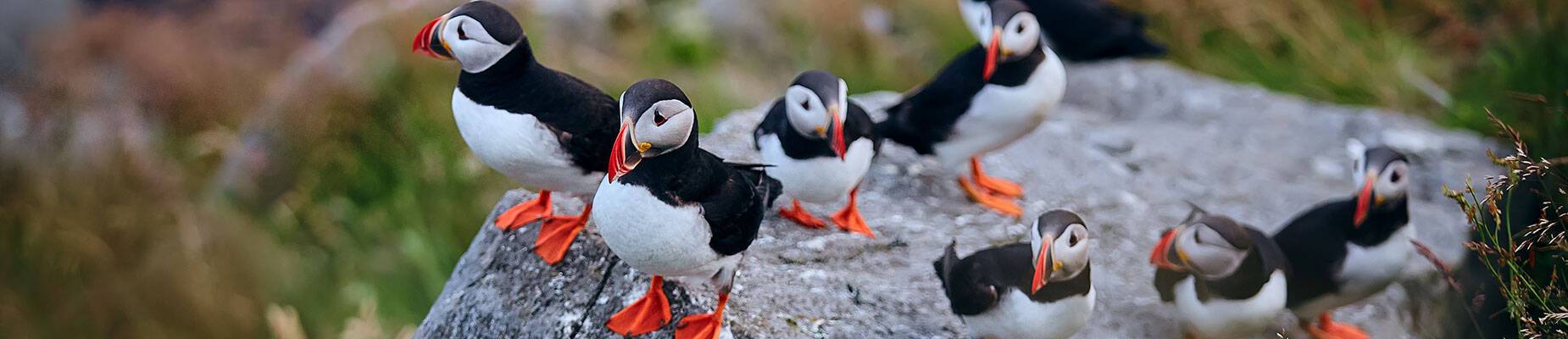
Sometimes affectionately referred to as “Clowns of the Sea,” Atlantic puffins are easily identifiable thanks to their short, colourful beaks and black and white plumage. During the breeding season, parts of Norway, like the island of Runde and the Lofoten Islands, are overtaken by over 150,000 pairs of breeding puffins. At this time, they nest in burrows on cliffsides and are often seen sitting on the rocks or bobbing about on waves.
Puffins' diets consist almost entirely of fish, like sand eels and herring. While feeding, they typically remain underwater for up to 30 seconds but can dive to 200 feet and remain submerged for up to a minute.
Eurasian Moose
Common Name: Eurasian Moose
Scientific Name: Alces Alces
Type: Mammal
Diet: Herbivore
Size: Up to 6.5 ft.
Weight: Up to 1,543 pounds
Known as the “King of the Forest,” the native Eurasian moose is the unofficial symbol of Norway. They roam freely across the country and are excellent swimmers, which makes them easy to migrate. They are also fantastic runners, gaining speeds of up to 35 miles per hour.
Though Eurasian moose are slightly smaller than North American moose, males can weigh up to 800 kilograms, and their antlers can grow to an incredible 2 metres. They are herbivores, feeding mostly on aquatic plants, leaves and bark. Moose have poor vision, but they compensate with a remarkable sense of smell and hearing.
Musk Ox
Common Name: Musk Ox
Scientific Name: Ovibos Moschatus
Type: Mammal
Diet: Herbivore
Size: Up to 4.9 ft.
Weight: Up to 800 pounds
Musk oxen arrived in Norway from Greenland in the late 1940’s and have become an important part of the Norwegian ecosystem. They prefer to live in mountainous regions, particularly the Dovrefjell, in herds of up to 24 individuals. They breed during the height of summer when males fight one another until one is defeated.
The musk ox is a herbivore, feeding on grasses, lichen, woody plants, mosses and sometimes Arctic willow. In winter, they use their hooves to cut through the snow, which in turn makes it easier for other small animals to feed and nearby carnivores to hunt. Musk oxen weigh up to 800 pounds and can run at speeds of up to 37 miles per hour.
Polar Bear
Common Name: Polar Bear
Scientific Name: Ursus Maritimus
Type: Mammals
Diet: Carnivore
Size: Up to 8 ft.
Weight: Up to 1,600 pounds
The polar bear is the world’s largest bear and land carnivore. To see them on your cruise to Norway, you’ll need to ensure you sail to Svalbard, where there are more polar bears than humans. The Norwegian island of Svalbard lies between Norway and the North Pole, offering wild, rugged Arctic tundra that is the ideal breeding ground for polar bears.
Male polar bears can weigh up to 1,600 pounds and swim for days at a time, using ice floes to capture their prey, primarily ringed and bearded seals. They are specialised predators that consume the fat and skin of their prey for energy. The best time to see them in Svalbard (which is one of the only places in the world to do so) is between May and September.
Sperm Whale
Common Name: Sperm Whale
Scientific Name: Physeter Macro
Type: Mammal
Diet: Carnivore
Size: Up to 67 ft.
Weight: Up to 57 tonnes
The sperm whale is the world’s largest toothed whale and one of the most memorable wildlife sightings you can hope for on a cruise to Norway. They’re most commonly spotted in Northern Norway, particularly around the Vesteralen Islands, where deep waters close to shore create an ideal feeding ground.
Sperm whales are deep-diving hunters that feed mainly on squid, and they can stay underwater for long periods before surfacing to breathe. The best time to see them in Norway is typically between May and September, when sailing conditions and daylight hours make spotting wildlife at sea much easier.
White-Tailed Sea Eagle
Common Name: White-Tailed Sea Eagle
Scientific Name: Haliaeetus Albicilla
Type: Bird
Diet: Carnivore
Size: Up to 8 ft.
Weight: Up to 15 pounds
The white-tailed sea eagle is one of Europe’s largest species of prey and a spectacular sight along Norway’s rugged coastline. Often spotted soaring above fjords or perched on rocky outcrops, these majestic birds are particularly common in Northern Norway and the Lofoten Islands.
With an impressive wingspan of up to eight feet, white-tailed sea eagles feed mainly on fish and seabirds, swooping down to catch prey with powerful talons. They can be seen throughout the year in Norway, making them one of the most reliable wildlife sightings on a Norway cruise.